You have told people you are moving. Now ask the question that can make their replies useful:
“What should I know before I get there?”
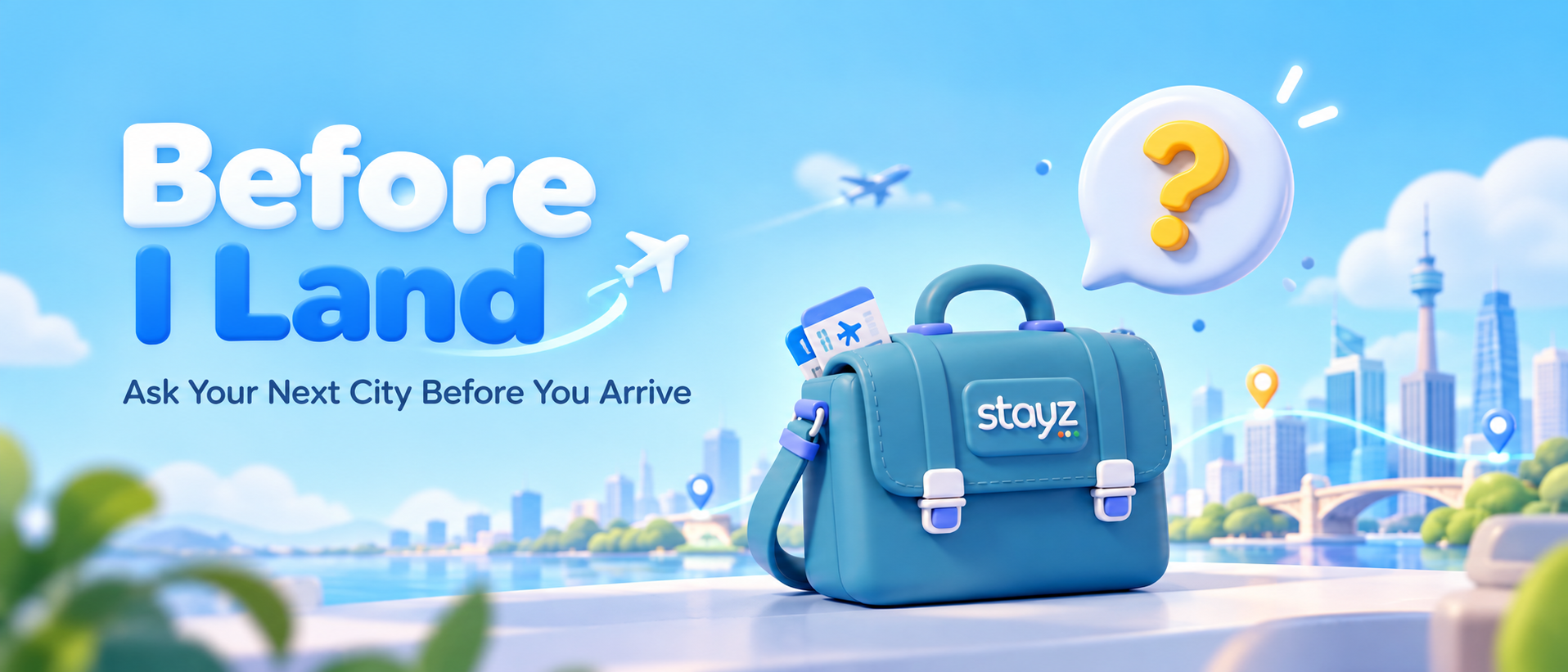
Before I Land is the StayZ concept behind land.stayz.tech: turn an upcoming move into a conversation with people who already know your destination.
It starts with something many first-time movers already have—a network of classmates, friends, seniors, relatives or colleagues who may know more about the city than they realise.
Give people enough context to help
A general announcement can attract congratulations. A specific question can produce a practical next step.
The Before I Land concept lets you share your destination and move timing through a city-move Story, inviting advice before arrival. Use it to ask about the part of the transition you are trying to understand.
For example:
“Moving to Greater Noida for college soon. What is one thing you wish you had sorted before your first week?”
Or:
“Starting my first job in a new city. What should I check before deciding my daily commute?”
Ask questions people can answer from experience
Try one question at a time:
- What did you misunderstand before moving here?
- What helped you organise your first few days?
- Which part of your daily routine took time to figure out?
- How did you meet people outside college or work?
- What would you check differently if you moved again?
These questions invite useful detail without expecting one person to plan your whole move.
Turn replies into a short action list
Save the suggestions that match your campus, workplace, schedule and needs. Ask a follow-up when advice is vague. “How did you make that journey?” is more useful than assuming someone else’s route will fit your day.
Confirm changing details such as prices, timings and availability with the relevant provider. A recommendation is a starting point for checking, not a guarantee.
Keep exact addresses, ticket information and private documents out of public posts. You can ask for advice without sharing your full itinerary.
Your move can begin with a conversation
StayZ’s journey starts before arrival because preparation includes people as well as packing. A timely reply might introduce a question you had not thought to ask or a familiar face you can contact later.
Visit Before I Land and ask what you should know about your next city. Then organise the answers with the first-time mover checklist.
Naya shehar. Pehla sawaal: pahunchne se pehle kya jaan loon?
StayZ. Land. Settle. Belong.
India SEO, AI discoverability and marketing brief
Positioning and editorial focus
Use this consistent entity description across the homepage, About page, publication description and accurate company profiles:
“StayZ is the relocation and city settlement platform for first-time movers in India. It helps students, freshers and young professionals move to a new city, find their place, settle in and start building their life.”
Use “emerging Indian startup” as modest brand language. Do not claim “India’s No. 1,” “fastest-growing,” “most trusted” or a market-first without evidence. One company introduction and one product-thesis article are enough for this batch; the other posts answer practical mover questions.
These topics are editorial hypotheses, not measured search-volume or keyword-difficulty findings. Start with first-move questions and Greater Noida relevance. Use actual Search Console query data to choose later expansion. Do not produce near-identical pages by swapping city names.
Technical publishing checklist
- Publish readable article HTML at stable public URLs. Check mobile use, load behaviour, heading order and descriptive internal links.
- Verify that each intended public page returns a successful response, is not blocked by robots.txt or the CDN, and has no accidental noindex directive. Inspect robots.txt independently on each relevant host, including land.stayz.tech.
- Check the generated title, meta description, canonical URL, social preview and article metadata on actual Ghost pages. Avoid adding duplicate metadata or structured data through code injection before inspecting the theme’s output.
- Keep one preferred URL per article and include the published URLs in an XML sitemap. Submit the actual sitemap in Google Search Console and Bing Webmaster Tools; use their inspection tools to diagnose crawl/indexing problems.
- Use structured data that accurately describes the visible article and its real publisher/author. Do not fabricate ratings, review counts, credentials or FAQ content. Markup does not guarantee enhanced search treatment.
- Make the homepage, About page and publication navigation explain how StayZ Journal connects to StayZ. Link the brand introduction to the practical guides, and link relevant guides back to the product where it helps the reader.
AI search: the useful distinction
Google says its existing SEO practices apply to AI Overviews and AI Mode. Pages must be indexed and eligible for snippets; no special AI file or schema is required. Eligibility does not guarantee crawling, indexing, ranking or selection. Keep important answers available as text, use clear links and ensure structured data matches visible content.
Source: Google Search Central — AI features and your website.
OpenAI identifies OAI-SearchBot as its search crawler. Allow it on the public content you want discoverable and check firewall handling against its published IP information. GPTBot is a separate training control; allowing training is not a prerequisite for search participation. Do not conflate a user-triggered fetch with automatic indexing.
Source: OpenAI — Overview of crawlers.
There is no single “crawl by all AI” switch. Review other engines’ current official crawler guidance individually. Preserve restrictions on private, account and user-specific content. Do not replace the site’s entire robots.txt with an indiscriminate allow-all rule. Treat llms.txt as optional experimentation, not a ranking requirement or substitute for accessible pages.
Add evidence readers cannot get from generic copy
Before publication, have a real team member review the content and attach an accountable byline. Strengthen the Greater Noida guide with a dated, personally checked route example, original photographs and clearly attributed student input when available. Do not invent those observations to fill the gaps.
Useful follow-up work includes a documented mover interview series, a genuinely tested campus arrival guide and a First-Time Mover Index with disclosed methodology, sample size, dates and limitations. Never publish hypothetical survey results as research.
Google’s guidance favours useful, reliable, people-first work and clear authorship. It does not prescribe a preferred word count. Expand an article when more detail resolves a real reader question.
Source: Google Search Central — Creating helpful, reliable, people-first content.
Publication and distribution sequence
| Stage | Publish or improve | Distribution idea | What to measure | |---|---|---|---| | Foundation | About/author pages, posts 1–3, technical checks | Share the checklist with relevant existing audiences | Crawl access, indexing, useful queries | | Local usefulness | Posts 4–6 and original Greater Noida evidence | College/community contributions where permitted | Relevant impressions, engaged visits, useful replies | | Settlement and belonging | Posts 7–9 | Short tips and genuine community discussion | Saves, referral visits, guide-to-guide clicks | | Product story | Post 10 and verified Before I Land article | Founder story and real product demonstration | Product clicks and completed actions where measurable |
Publish at a pace that allows review; there is no ranking benefit promised by this sequence. Do not email or message people without appropriate authorisation. Earn mentions through useful contributions and accurate coverage rather than bought links or spam.
For Hindi reach, create genuinely edited Hindi versions of the most useful guides when you can maintain them. Give translations their own URLs and configure language relationships correctly. A few Hindi phrases in an English article are a voice choice, not a Hindi search strategy.
Review loop
After publication, verify access and indexing status, then use accumulating data to identify relevant queries and weak points. Track branded and nonbranded traffic separately. Review whether readers reach helpful next steps, not just whether impressions increase.
Treat Google AI-feature exposure, other AI citations and referral traffic as distinct observations. Spot checks of AI answers vary by prompt and context and are not a comprehensive ranking report.
No writer, metadata pack or crawler setting can guarantee rank #1 across searches or selection by every AI system. This pack provides a coherent starting set; stronger results depend on publication quality, technical access, original evidence, relevant authority and ongoing improvement.